

Hair & Makeup Masterclass — Lecture 4: Skin Prep & Long-Wear Base (A Calm, Flawless Complexion System)
The most beautiful makeup doesn’t start with foundation. It starts with care. Skin prep is where artistry becomes a real experience—where a client feels supported, safe, and gently guided into a version of themselves that feels more polished, more radiant, and more at ease. When prep is done correctly, makeup looks smoother, wears longer, and feels lighter on the skin. When prep is rushed or mismatched, even expensive products struggle.
This lecture is your professional, repeatable system for building a long-wearing base that still looks like skin. We’re going beyond “use moisturizer and primer” and into the real work: reading the skin, choosing the right textures, layering with intention, and setting strategically—especially in warm climates, long events, studio lighting, and everyday life where real faces move and breathe.
If your goal is to grow as a freelance makeup artist , book more clients searching for a makeup artist Miami , or build strong fundamentals that would hold up in a makeup school Miami or hair and makeup school Miami environment—this is one of the most important lectures in the entire course. A flawless base is not a trend. It’s a skill. And clients notice it immediately.
Masterclass Series: This is Lecture 4 of a 30-lecture Hair & Makeup Masterclass.
Mentorship Registration: Click here to register
Featured image tip: Use the Lecture 4 cover as your WordPress Featured Image.
What You’ll Learn in Lecture 4
- How to “read” the skin in 60 seconds (so you prep correctly every time)
- A step-by-step prep routine that works across skin types and ages
- Primer and foundation pairing (no more separation, patchiness, or pilling)
- How to create long wear without heavy makeup
- Strategic setting: where to powder, where to avoid, and when to use mist
- Client-friendly scripts that sound warm, not clinical
- Case studies for real situations: humidity, texture, mature skin, dryness, oil, redness
- Practice drills + a mini “base routine” homework plan
Table of Contents
- The Philosophy of Skin Prep
- How to Read Skin in 60 Seconds
- The Skin Prep Blueprint
- Primer + Base Pairing (No More Pilling)
- Application Techniques: Thin Layers That Look Like Skin
- Setting Strategy: Powder, Mist, and Longevity
- Heat & Humidity: The Long-Wear Method
- Case Studies (Real Client Situations)
- Common Base Problems (and Fixes)
- Client Experience: Warm, Reassuring Language
- Beauty Psychology: Confidence, Presence, and Self-Respect
- Practice Drills + Homework
- Register for Mentorship
The Philosophy of Skin Prep
Skin prep is not about doing “more.” It’s about doing the right things in the right order, for the skin that’s in front of you today. One client needs hydration and comfort. Another needs oil control in specific areas. Another needs smoothing and gentle blur because texture is the main concern. The professional approach is simple: listen to the skin, then build the base.
A long-wear base is not created by heavy foundation. It’s created by thoughtful prep, lightweight layering, and smart setting. When the base is built correctly, it doesn’t just last—it still looks beautiful in motion: smiling, speaking, hugging, dancing, and living. That’s what clients remember when they say, “My makeup looked amazing all night.”
Lecture 4 mindset: We’re not “covering” someone. We’re supporting them—helping skin look smoother, more even, and more radiant while still feeling like themselves.
How to Read Skin in 60 Seconds
Before you reach for primer or foundation, you need a fast skin read. This is what separates artists who guess from artists who consistently deliver. Here’s a quick, professional scan you can do while greeting the client and setting up:
1) Surface Texture
Look for visible dryness, flaking, rough patches, or makeup residue from earlier in the day. Texture tells you whether the skin needs more comfort (hydration) or more smoothing (a blurring prep approach).
2) Oil Pattern
Notice where oil tends to show: usually the T-zone (forehead, nose, chin). The mistake is trying to “matte the entire face.” Most clients need targeted oil control, not blanket dryness.
3) Redness and Sensitivity
Redness can signal sensitivity, irritation, or simply natural flush. Your base approach becomes gentler and more soothing in these cases. Lightweight, calm layers usually look better than heavy coverage that emphasizes texture.
4) Under-Eye Needs
Under-eyes are their own zone. They can be dry even when the T-zone is oily. Treat under-eyes with comfort and thin layers—this is one of the most common areas for creasing and “cake.”
5) Event + Wear Time
Ask: “How long do you need your makeup to last?” and “Is this for flash photography, outdoor heat, or a long day?” The wear environment influences everything: how you prime, how you layer, and how you set.
The Skin Prep Blueprint
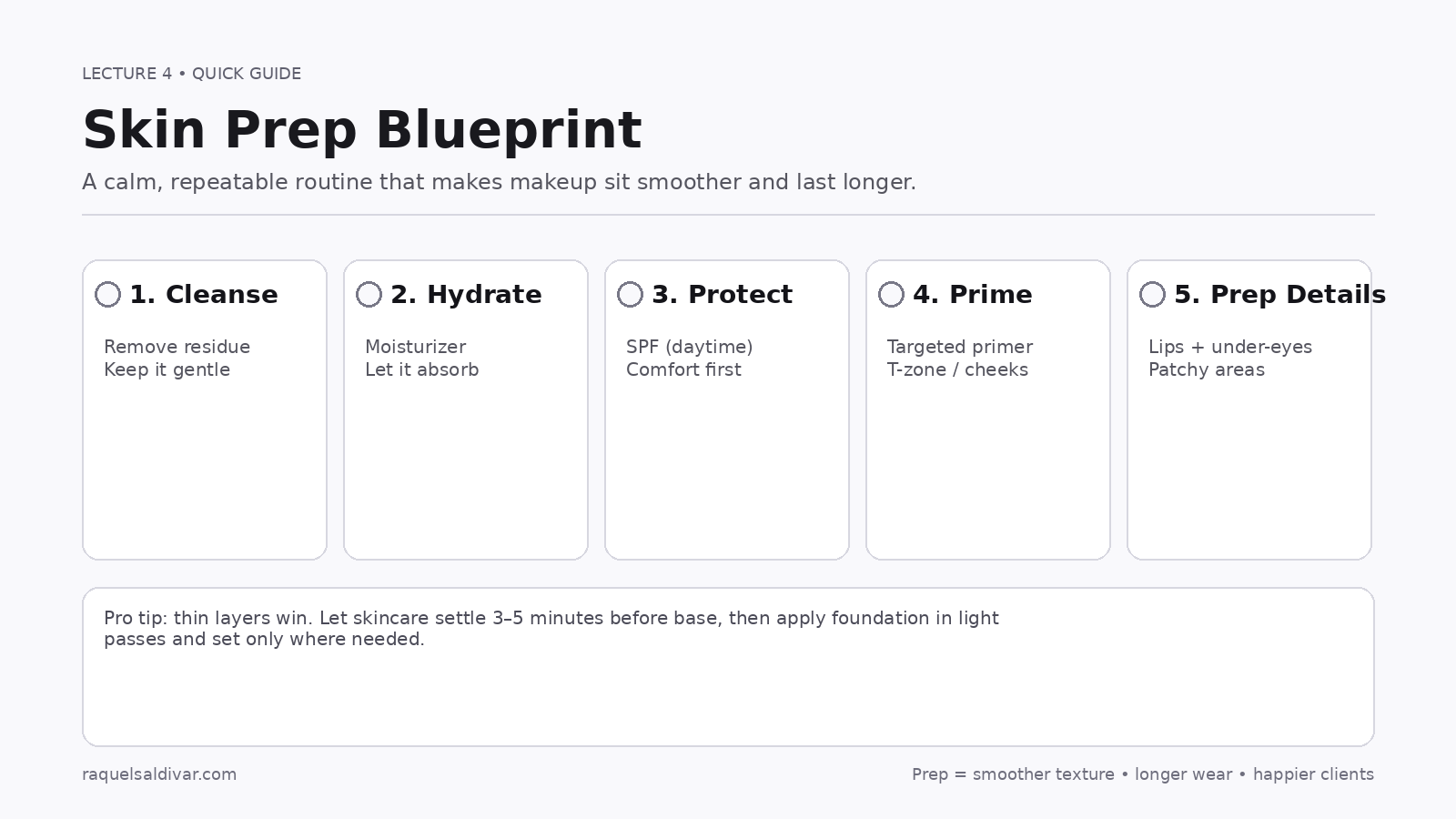
This is the routine you can repeat on almost any client—with small adjustments based on your skin read. It’s designed to feel calm, not rushed, and it’s structured so the client feels cared for from the first step.
Step 1 — Cleanse (Even if the client “already did”)
Cleansing isn’t about stripping the skin. It’s about removing residue—oil, sweat, skincare that didn’t absorb, or environmental buildup— so your base has a clean surface to grip. A gentle cleanse or micellar-style wipe can be enough. The key is to keep it comfortable.
Step 2 — Hydrate (Comfort is the secret to smoothness)
Hydration is what prevents makeup from catching on texture and separating around the mouth, nose, and cheeks. Use a moisturizer that suits the skin’s needs, then give it time—three to five minutes to settle is often the difference between “flawless” and “patchy.” If time is tight, use gentle pressing motions and keep layers thin.
Step 3 — Protect (SPF when appropriate)
Daytime clients often wear SPF. The professional approach is not to fight it; it’s to work with it. If SPF is sticky or heavy, you’ll adjust primer and base texture. If the SPF is comfortable, it can improve the overall finish. The goal is: protection without disrupting wear.
Step 4 — Prime (Targeted, not aggressive)
Primer is not a universal step. It’s a tool. Use it where it solves a problem: mattify T-zone, blur pores, smooth texture, or add comfort to dry areas. A professional base often uses two primers: one for oil control (T-zone) and one for comfort (cheeks).
Step 5 — Prep Details (Under-eyes + lips + texture zones)
Under-eye prep matters. Lip prep matters. Patchy texture zones matter. You can prevent most creasing and cracking simply by giving these areas the right amount of comfort and the lightest layers possible.
Primer + Base Pairing (No More Pilling)
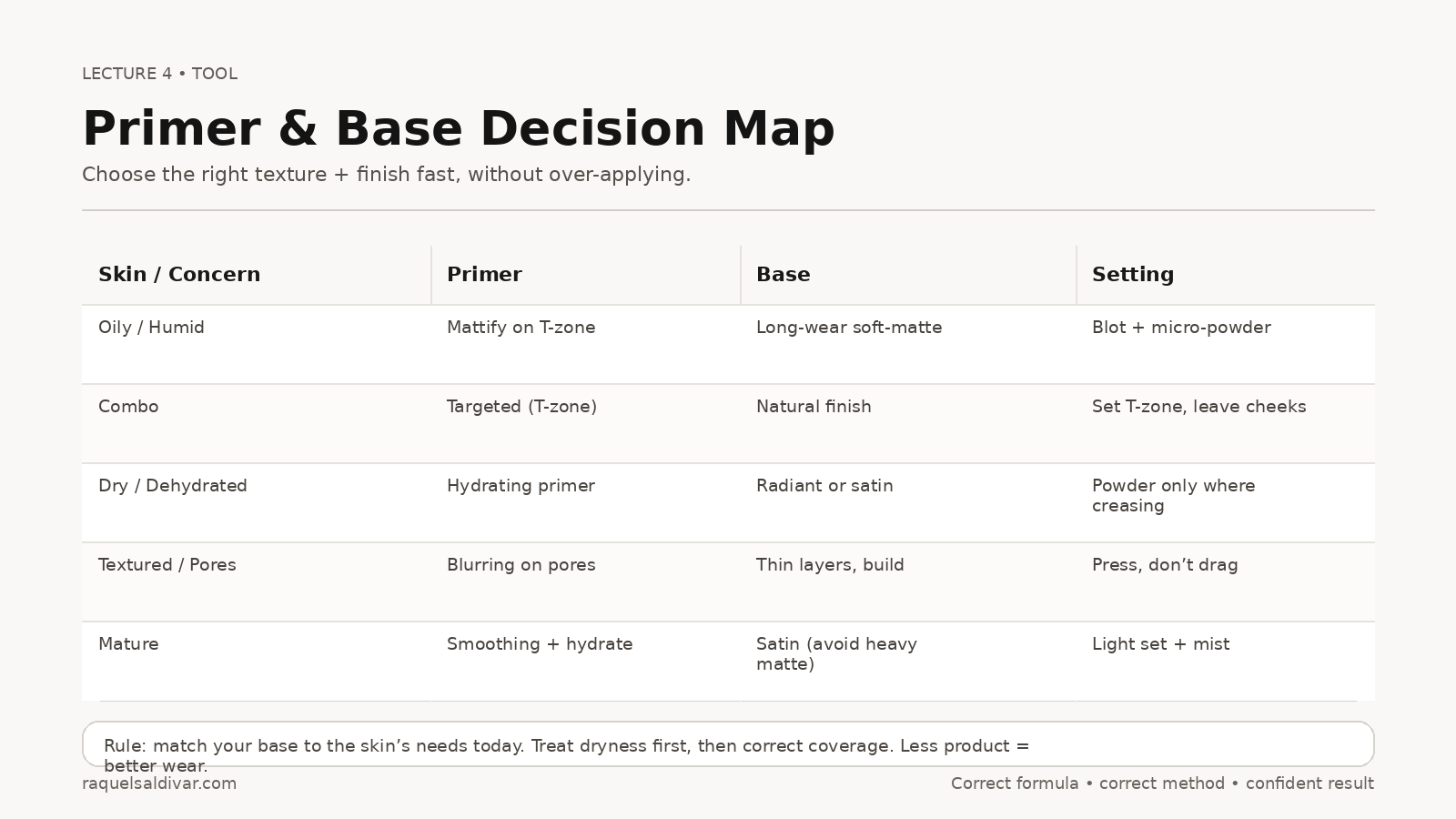
One of the biggest reasons base fails is mismatch: primer and foundation textures that don’t like each other, or too many layers too quickly. A professional pairing strategy is simple:
- Let skincare settle. Rushing is the #1 cause of pilling.
- Keep layers thin. Long wear comes from adhesion, not thickness.
- Match textures intentionally. If the skin is dry, don’t stack drying formulas.
- Test on the jawline. You’ll catch pilling or separation before it ruins the face.
Use the decision map below to choose the right direction quickly. This is especially helpful during busy days when you’re working back-to-back clients and need a reliable system.
Register Now for Personalized Training with Raquel
Want your base routine reviewed and refined so your makeup looks smoother, lighter, and longer-wearing? Register now to schedule your next personalized training session with Raquel. Click below to register, and one of our representatives will contact you to confirm the details.
Click Here to RegisterAfter you register, our team will reach out to schedule your session and answer any questions.
Register for Mentorship
Want Raquel to refine your prep + base routine so your makeup looks smoother, lighter, and longer-wearing? Register here and one of our representatives will contact you:
You’ll leave with a personalized plan you can repeat on clients confidently—every time.
Educational content only. Always follow local guidelines and best practices.

Comments are closed